Welcome to Nazar Haidri at Moorfields
From Monday 5th Oct 2026
Moorfields Eye Hospital Dubai is a renowned extensions of Moorfields Eye Hospital London, the world’s oldest and one of the largest centres for ophthalmic treatment, teaching, and research.
Celebrating the art of Nazar Haidri
A special selection of original works by Nazar Haidri, an accomplished Pakistani artist and Moorfields patient, is being presented at Moorfields Eye Hospital Dubai.
The presentation brings together selected works from Nazar's artistic journey, exploring music, cultural heritage and Islamic calligraphy, alongside his distinctive approach to colour, form and composition.
Visitors have the opportunity to view and acquire original works by the artist at special Moorfields prices.
Special Moorfields prices are available from Monday 5th October until the presentation closes.
1/ Surah Yousuf (12:87)
Acrylic on Canvas (Islamic calligraphic composition)
Artist's Standard Price: AED 15,000
Special Moorfields Price: AED 12,000
A message of hope, patience and faith
This work presents a calligraphic interpretation of Verse 87 of Surah Yusuf, one of the Qur'an's most moving passages concerning hope in the face of hardship.
In the verse, Prophet Ya'qub (Jacob) tells his sons to search for Yusuf (Joseph) and his brother, while reminding them not to despair of Allah's mercy. The passage comes at a moment of profound uncertainty in the story of Yusuf, making its message of perseverance and hope particularly poignant.
The Arabic inscription is presented as the central visual element of the composition, with the flowing forms of the calligraphy integrated into a field of blue and silver. The gold accents add warmth and emphasis, creating a work that brings together faith, artistic expression and the enduring human message of hope.
Prefer WhatsApp? Contact us directly.
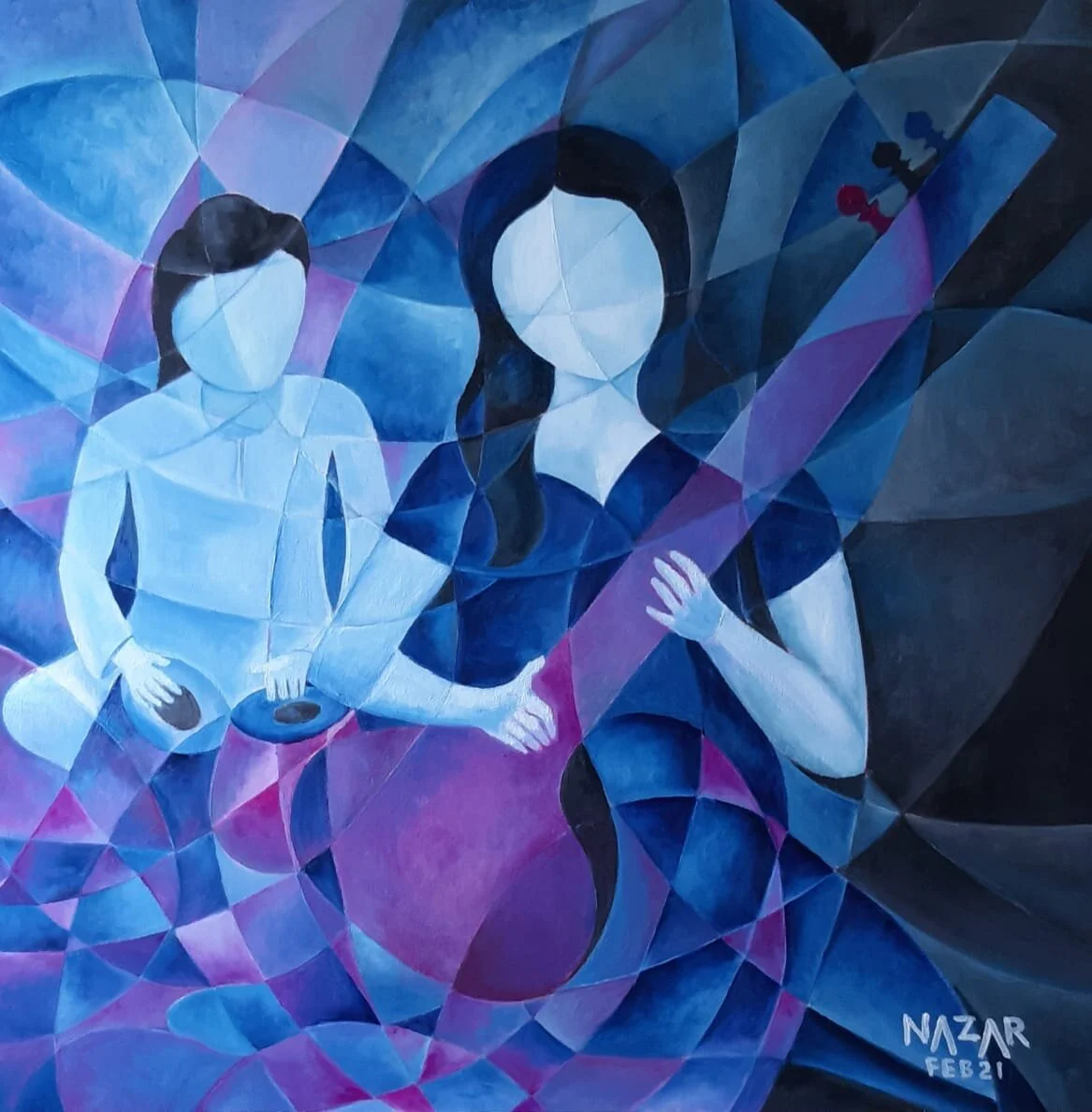
2/ Balochi Musician Playing Rubab
Acrylic on Canvas (Cubism composition)
Artist's Standard Price: AED 13,000
Special Moorfields Price: AED 10,000
An instrument with a long history across Central and South Asa
The rubab, also written rabab or rebab, is one of the great traditional string instruments of the broader Persianate and Central Asian world. Its history crosses modern national boundaries, with forms of the instrument found across Afghanistan, Pakistan, Iran and neighbouring regions. The rubab also played an important role in the evolution of North Indian classical instruments; The Metropolitan Museum of Art notes that the rabab preceded the sarod in the development of North Indian musical traditions. The Metropolitan Museum of Art
In this painting, Nazar Haidri places the Balochi musician at the centre of the composition, connecting the instrument with the cultural traditions of Balochistan and the wider musical heritage of the region.
Prefer WhatsApp? Contact us directly.
3/ Violin & Sitar Jugalbandi
Acrylic on Canvas (Pointillism composition)
Artist's Standard Price: AED 12,000
Special Moorfields Price: AED 9,500
When two musical voices meet
The word jugalbandi describes a musical dialogue between two solo performers. Rather than one musician simply accompanying the other, the two performers respond to one another, developing musical ideas together. The tradition has become an important feature of Indian classical performance, particularly in instrumental collaborations. Saarey Music
The sitar itself reflects centuries of cultural exchange. Its development incorporates influences from the Persian setar and Indian vina, while its modern form evolved within the musical traditions of the Indian subcontinent. The Metropolitan Museum of Art
Nazar's pairing of violin and sitar therefore represents more than two instruments: it evokes a conversation between different musical traditions, united through performance.
Prefer WhatsApp? Contact us directly.
4/ Flute Recital
Acrylic on Canvas (Pointillism composition)
Artist's Standard Price: AED 12,000
Special Moorfields Price: AED 9,500
One of the oldest voices in Indian musical tradition
The flute has an exceptionally long history in South Asian music. Flute-like instruments appear in the ancient musical and cultural traditions of the Indian subcontinent, and the instrument has long been associated with the expressive qualities of the human voice.
In Indian classical music, the flute can serve as a melodic instrument capable of subtle ornamentation and sustained expression. Its simplicity of construction contrasts with the extraordinary control required to produce the nuances of a classical performance.
Nazar Haidri's Flute Recital captures the musician in a moment of concentration, transforming a familiar instrument into the focal point of a carefully constructed composition. The painting celebrates not simply the instrument itself, but the relationship between musician, breath and melody.
Prefer WhatsApp? Contact us directly.
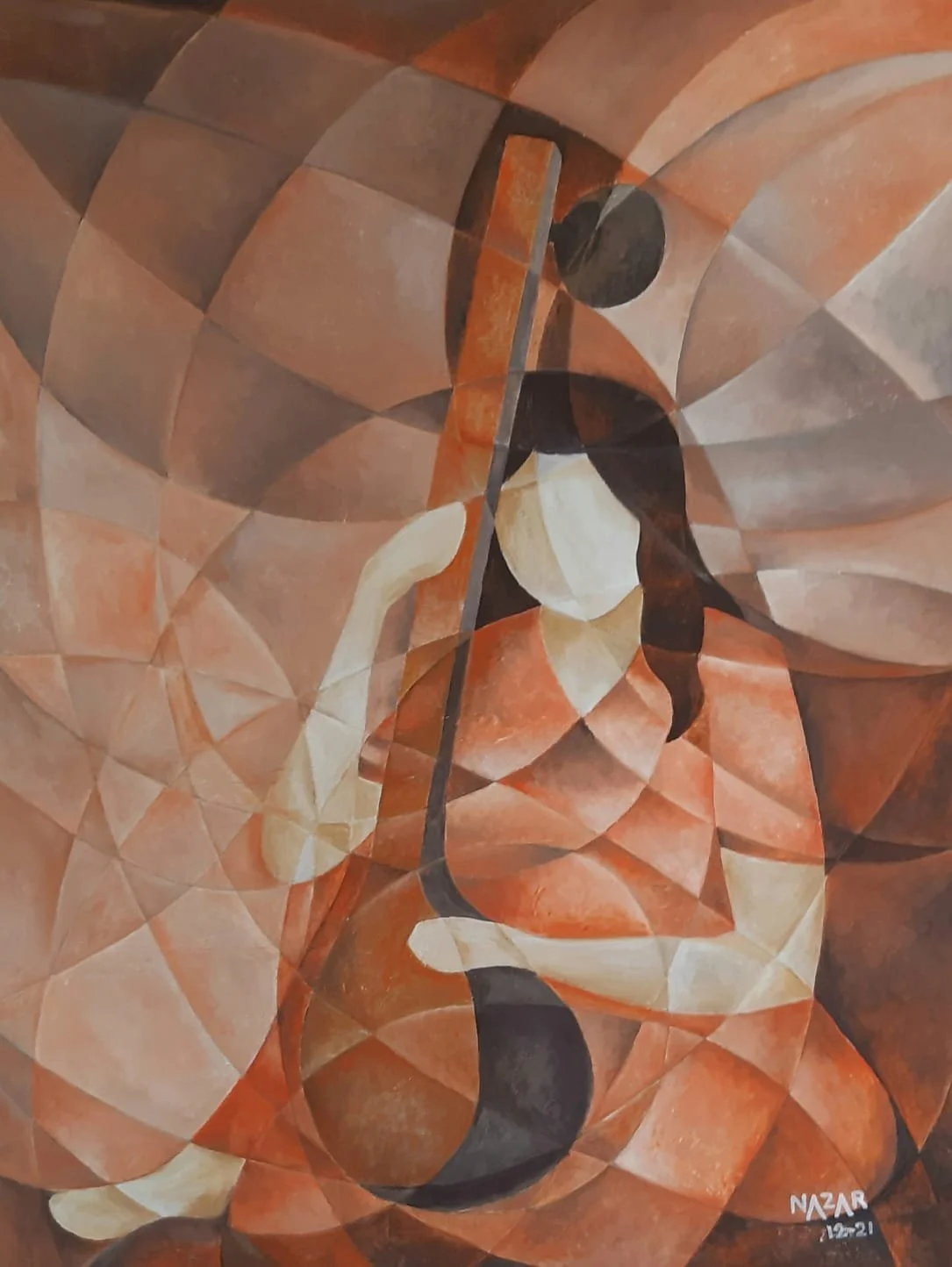
5/ Sitar Recital
Acrylic on Canvas (Cubism composition)
Artist's Standard Price: AED 10,000
Special Moorfields Price: AED 8,000
An instrument shaped by cultural exchange
The sitar is perhaps the most internationally recognised instrument associated with North Indian classical music. Its history reflects the cultural exchange that took place across the Indian subcontinent and the Persianate world. The Metropolitan Museum of Art notes that the modern sitar has roots in both the Persian setar and the Indian vina. The Metropolitan Museum of Art
The instrument became particularly prominent in North Indian musical culture and later achieved worldwide recognition through performers such as Ravi Shankar. The Metropolitan Museum of Art
Nazar Haidri's Sitar Recital focuses on the musician and instrument as a single visual presence. The painting invites the viewer to consider the sitar not merely as a musical object, but as part of a centuries-old tradition of melody, improvisation and artistic expression.
Prefer WhatsApp? Contact us directly.
6/ Raag Darbari on Tanpura
Acrylic on Canvas (Cubism composition)
Artist's Standard Price: AED 14,000
Special Moorfields Price: AED 11,000
The music of the royal court
Raag Darbari Kanada, commonly known simply as Darbari, is one of the most celebrated ragas of Hindustani classical music. Its name derives from darbar, meaning court, and its tradition is popularly associated with Miyan Tansen, the legendary musician of the court of Mughal emperor Akbar. The historical attribution should be treated as tradition rather than established fact, but the association has become central to the raga's identity. Darbar
Darbari is traditionally performed late at night and is characterised by a deep, serious and majestic character. Darbar
The tanpura, meanwhile, provides the continuous tonal drone that establishes the musical foundation against which the melodic performance unfolds. It is a supporting instrument rather than a melodic solo instrument, creating the sustained sonic environment in which the raga can breathe. The Metropolitan Museum of Art
Nazar Haidri's painting therefore brings together music, history and the atmosphere of the royal court in a single composition.
Prefer WhatsApp? Contact us directly.
7/ The Blue Mood
Oil on Canvas (Cubism composition)
Artist's Standard Price: AED 14,000
Special Moorfields Price: AED 11,000
An exploration of music, colour and emotion
Nazar Haidri has spent much of his artistic life exploring the relationship between music and visual expression. His musical paintings combine musicians and instruments with Cubist forms, using colour, movement and geometry to suggest the emotion and rhythm of music rather than simply depicting a performance. Nazar Haidri
In The Blue Mood, the violinist emerges from a composition of layered blue forms. The instrument and figure appear to flow into the surrounding geometry, creating a sense of movement while the restrained blue palette establishes the contemplative mood suggested by the title.
The violin itself has a long tradition as one of the world's most expressive bowed string instruments. Here, however, Nazar is less concerned with its literal representation than with the feeling of music translated into colour, shape and movement.
The result is a work that invites the viewer to experience music visually — through rhythm, harmony and mood.
Prefer WhatsApp? Contact us directly.
8/ The Violinist
Acrylic on Canvas (Cubism composition)
Artist's Standard Price: AED 14,000
Special Moorfields Price: AED 11,500
In The Violinist, Nazar Haidri transforms the act of playing the violin into a study of music, movement and emotion. Rather than portraying the musician as a conventional figure, he fragments the body, instrument and surrounding space into angular geometric forms, reflecting his exploration of Cubism.
The violin becomes the visual and emotional centre of the composition. Its long horizontal bow creates a powerful line across the canvas, while the musician's hands, instrument and body appear to merge with the surrounding geometric shapes.
The restricted palette of ochre, gold, charcoal, ivory and earthy tones gives the work a warm, contemplative character. The textured background adds energy and movement, suggesting that the music extends beyond the violin itself and into the space surrounding the performer.
The result is not simply a portrait of a violinist, but Nazar’s visual interpretation of how music can be translated into line, form, colour and emotion.
Prefer WhatsApp? Contact us directly.
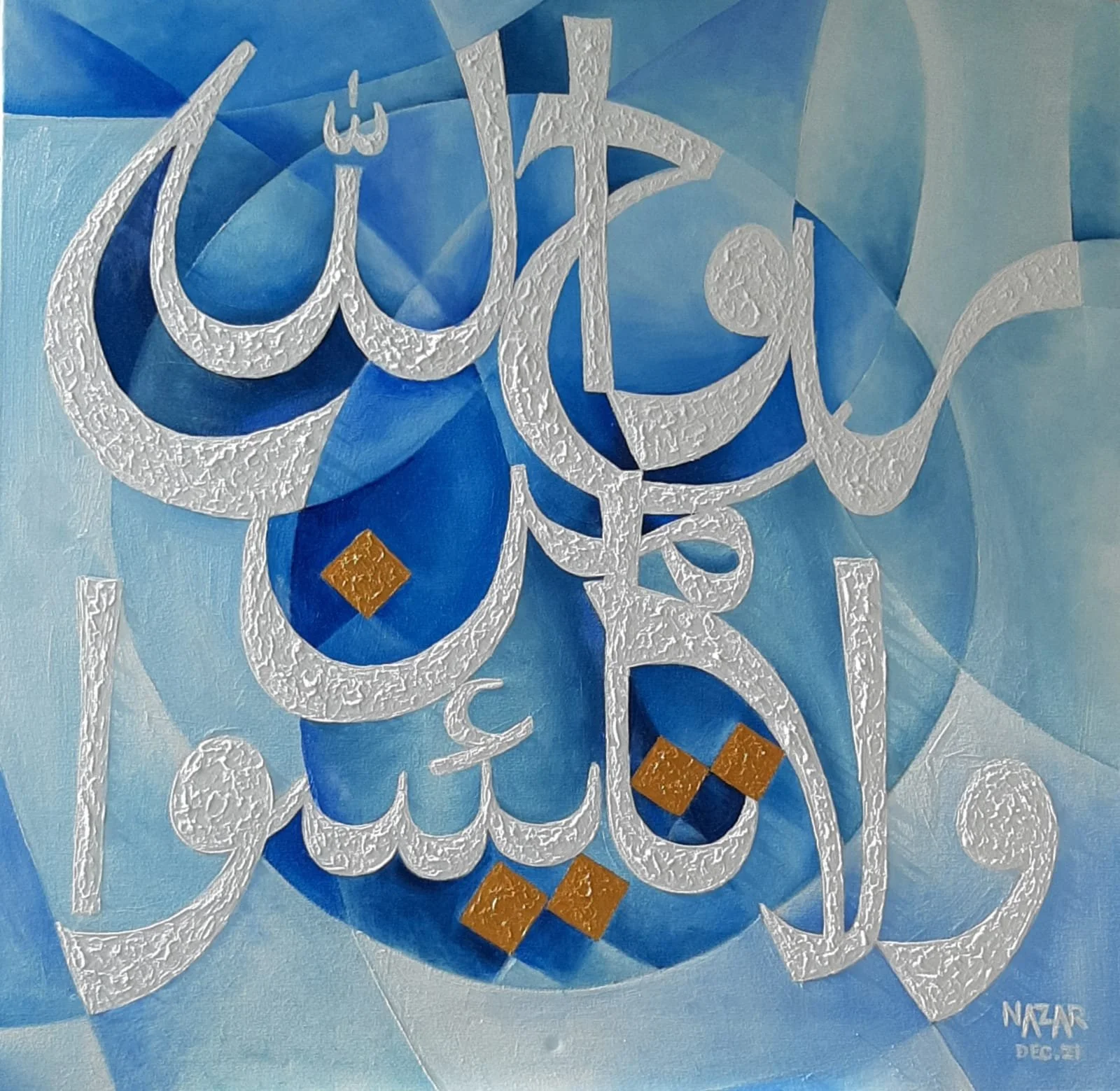
Surah Yousuf (12:87) Acrylic on Canvas
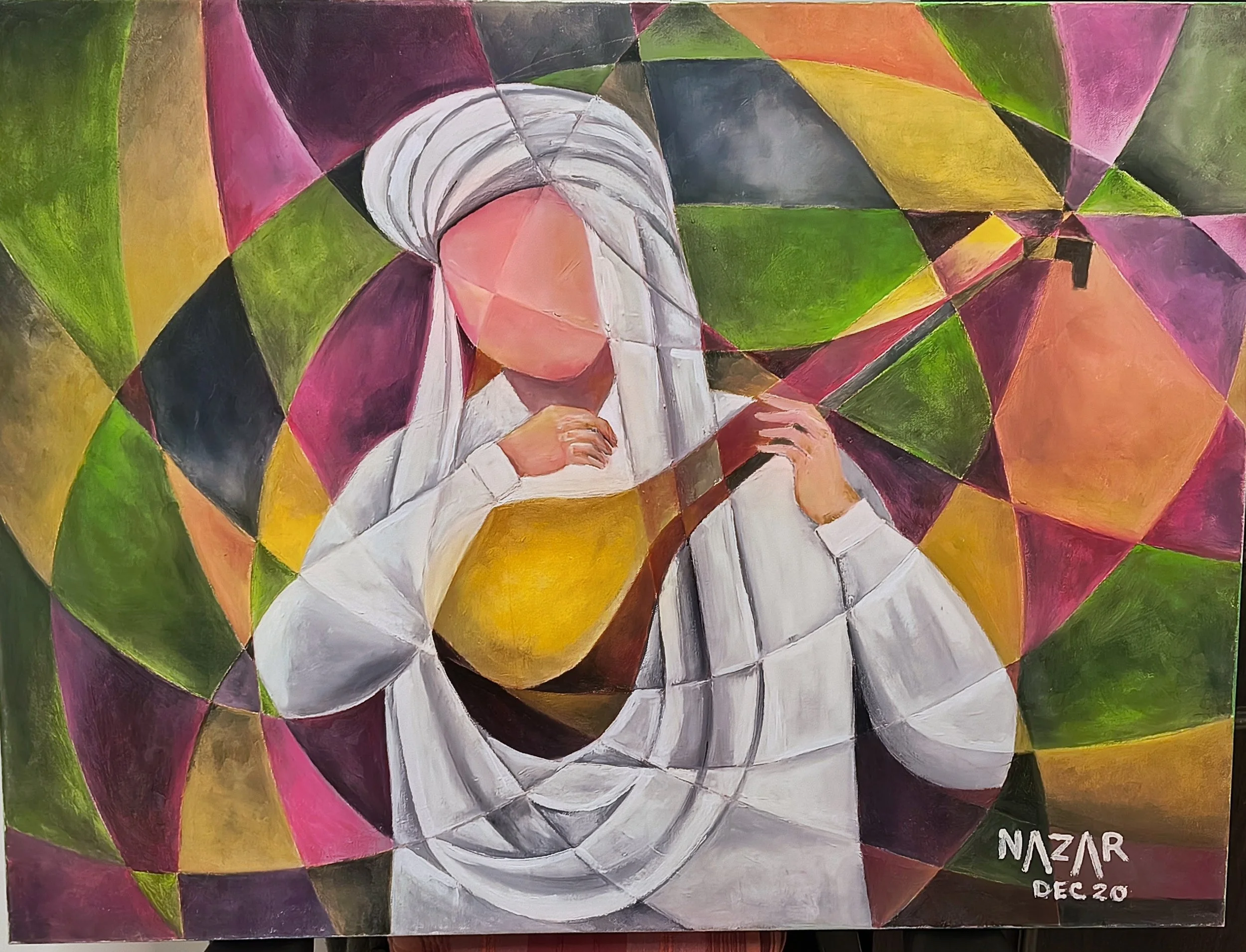
Balochi Musician Playing Rubab Acrylic on Canvas
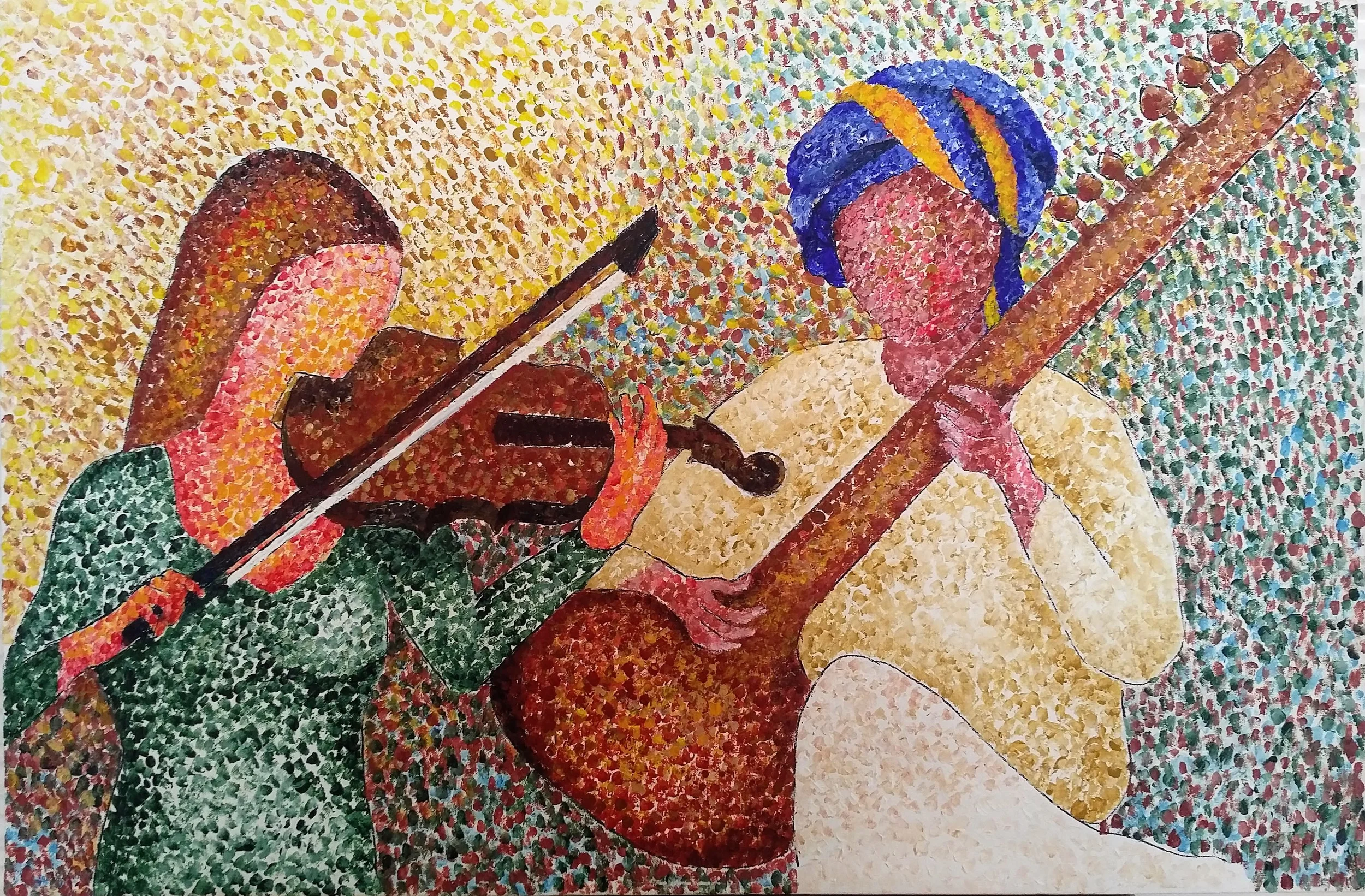
Violin & Sitar Jugalbandi Acrylic on Canvas
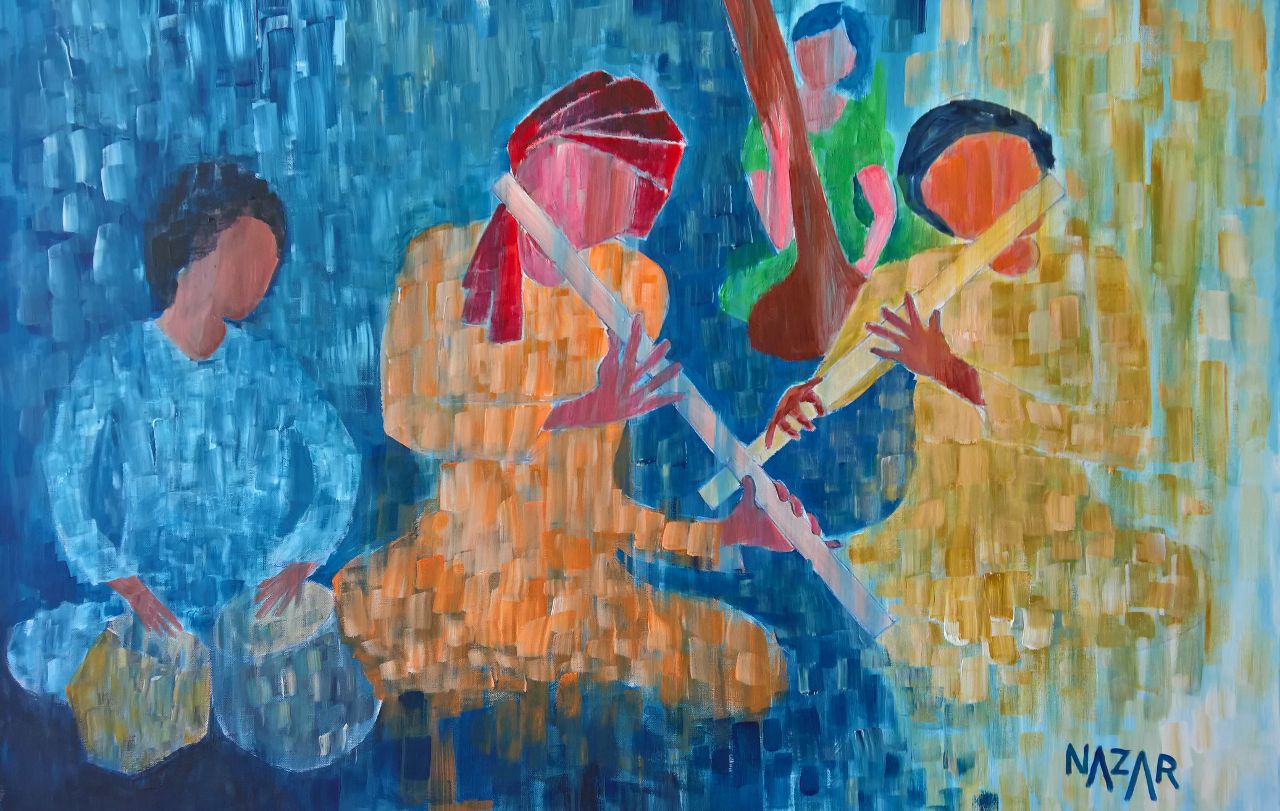
Flute Recital Acrylic on Canvas
Sitar Recital Acrylic on Canvas
Raag Darbari on Tanpura Acrylic on Canvas
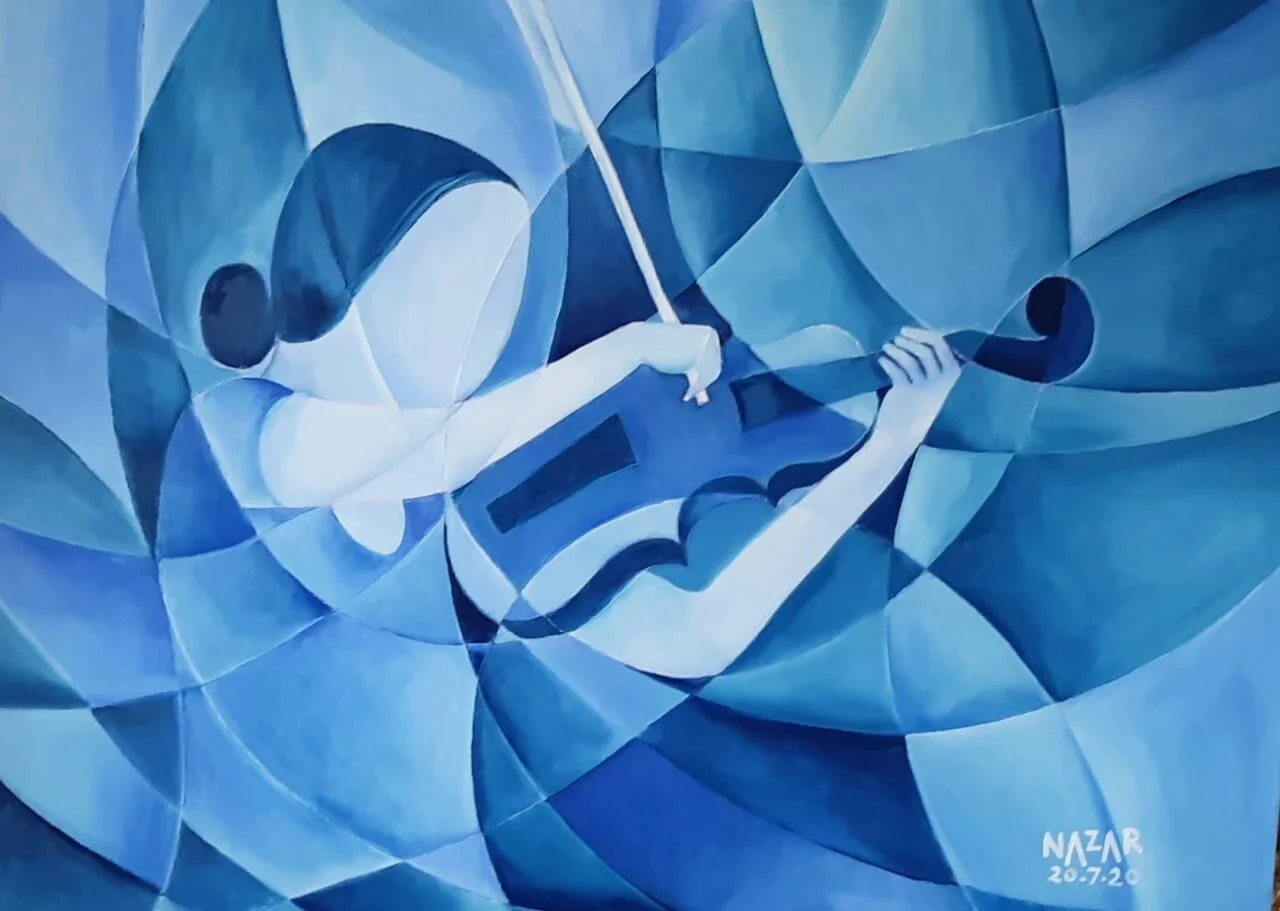
The Blue Mood Oil on Canvas
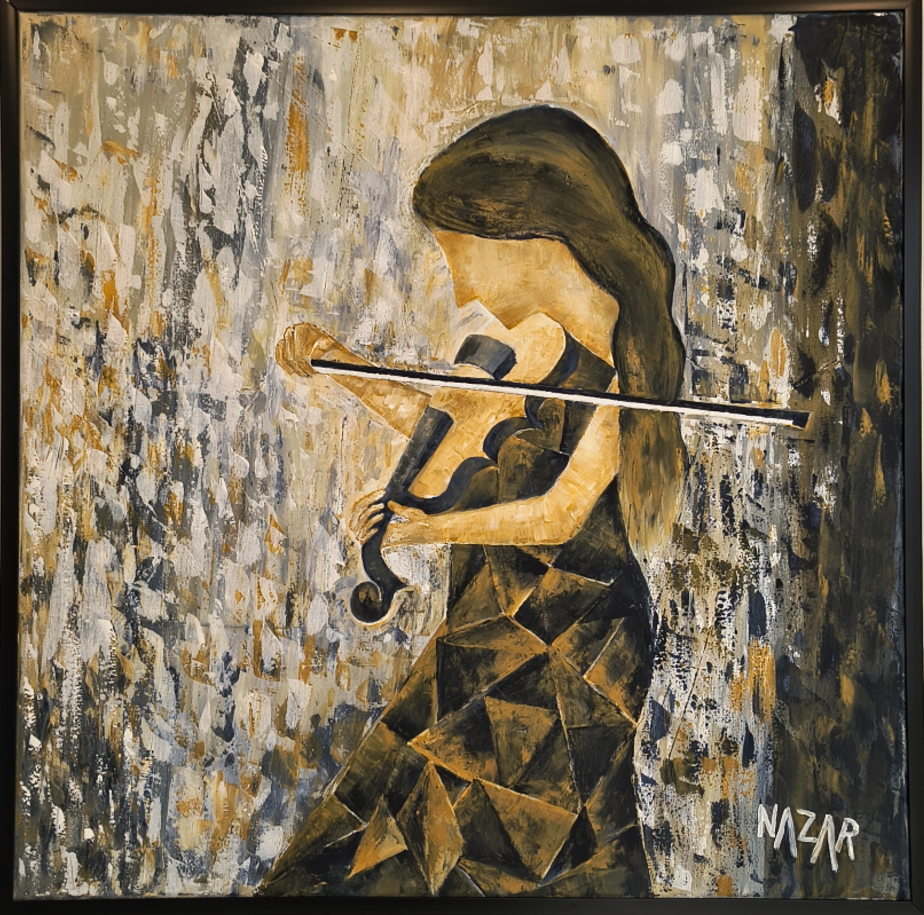
The Violinist Acrylic on Canvas